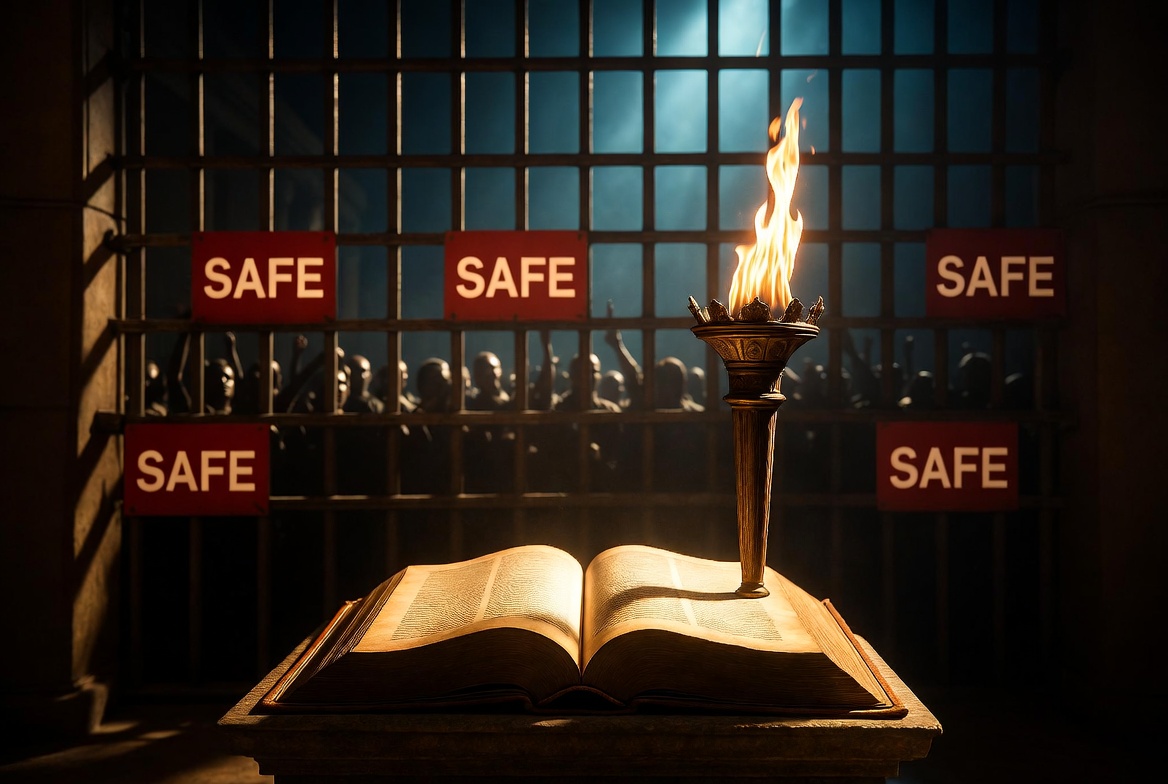
Free speech is the good. Safety is not a reason to give it up. The demand to limit speech in the name of safety, emotional safety, psychological safety, or protection from offense is a demand to stop the testing of claims. Once speech can be restricted because it unsettles someone, the power to decide what may be said has already moved. That power does not stay modest.
Do not sacrifice speech in the name of safety.
The difficulty begins when safety stops being one claim among others and becomes the standard by which speech is judged. In universities, workplaces, platforms, and public institutions, safety has expanded well beyond protection from physical harm. It now routinely includes emotional safety and psychological safety, protection from offense, from discomfort, and from the experience of being challenged. Once that expansion is accepted, free speech starts to look like a problem rather than a protection.
At that point the question is no longer how to balance liberty and safety. The question is what “safety” has been made to mean, and what speech has been given up to purchase it.
Benjamin Franklin’s warning still has force. Those who give up essential liberty to purchase temporary safety deserve neither. The warning assumes a recognizable tradeoff. Liberty on one side, safety on the other. The exchange, he suggests, is usually a bad one. That warning still applies. The present situation is different in one respect. The safety now being invoked is no longer mainly protection from violence or coercion. It is protection from the psychological and social effects of speech. Ideas are described as harmful, with harm stretched to include offense, discomfort, or the disturbance of settled beliefs. In stronger versions, speech itself is treated as a form of violence. The demand is not simply that people be kept safe from assault. It is that they be kept safe from having their views, identities, or moral certainties disturbed.
Free speech, in the sense that matters here, is not just the right to express yourself. It is the practical means by which claims are tested, errors are exposed, and power is forced to justify itself. Speech that actually does this work almost always unsettles someone. Once safety is expanded to include protection from that unsettlement, free speech is placed under suspicion by default.
If this expanded version of safety is treated as primary, the defense of free speech is made to sound callous. Why should anyone’s right to speak outweigh another person’s emotional safety? The question only sounds reasonable because the meaning of safety has already been changed. The real work is being done by the redefinition.
Once speech can be restricted in the name of safety, a second problem appears at once: who decides?
Every society that draws lines around expression has to answer this. Hate speech laws, rules against offensive language, policies on “harmful content,” and institutional speech codes all require someone to determine what counts as unsafe. Those standards vary widely. What one country treats as illegal hate speech, another protects. What one university calls harm, another treats as ordinary disagreement. There is no neutral, universal line waiting to be discovered. There are only particular judgments made by particular people under particular pressures.
In a connected world the difficulty grows sharper. Speech moves across borders in seconds. A statement made under one set of rules is received under another. The pressure for common standards increases, yet the underlying disagreements do not disappear. Attempts to impose a single rule do not settle the conflict. They only move the power to define it. Someone still decides what may be said. That someone now has wider reach.
This is not a technical detail. It is the permanent political problem inside every free speech restriction and every hate speech law. Once the category of unsafe speech exists, the power to fill that category becomes one of the most important powers available. History gives little reason to believe such power stays modest for long.
Watch what happens next. Safety begins as a claim about protecting people. It becomes something else when it turns into a justification for institutional control. The language stays benevolent. The effect is the steady expansion of managerial authority over what may be discussed, questioned, or doubted.
This is where safety crosses into a dictate of power. The shift is usually gradual. It starts with cases that seem obvious, like direct threats, clear incitement, targeted harassment. It then stretches toward broader categories of harm and emotional safety. Eventually the presumption flips. Speech is treated as something that requires permission, or at least a risk assessment, before it is allowed. At that stage the original claim has been absorbed into a system of administration. The live question is no longer whether a particular instance of speech creates a genuine and serious danger. The question is whether it has been properly processed according to the prevailing safety rules.
How much is too much? There is no clean numerical answer. But there is a usable test. When the language of safety is used mainly to protect people from the possibility of being wrong, from the friction of disagreement, or from losing control of a narrative, it has moved beyond protecting persons. It has become a way of managing thought. At that point safety is no longer functioning as a limit on harm. It is functioning as a limit on inquiry.
You can see the pattern in ordinary institutional life. A claim is not evaluated first on whether it is true or false. It is evaluated on whether it might make someone feel unsafe. The process becomes the point. Risk is minimized. Friction is treated as failure. Over time people adapt. They learn what cannot be said, or can be said only in careful, pre-approved ways. The public conversation does not vanish. It thins.
Follow this path far enough and the destination is visible. A society that treats emotional and psychological safety as paramount will systematically discourage the very speech most likely to expose error. It will prefer claims that affirm existing sensitivities and distrust claims that unsettle them. Institutions will build elaborate processes to manage linguistic risk. Individuals will police themselves. The range of thinkable thoughts narrows, not always by official decree, but by the steady accumulation of caution.
The justification for this direction was safety. Does the resulting environment actually provide it?
It may reduce certain forms of immediate discomfort. It does not reduce the deeper dangers that free speech exists to confront. The danger of unexamined power, the danger of collective error that goes unchallenged, and the danger of a society that loses the ability to correct itself. A culture that cannot tolerate serious dissent is not safer in any lasting sense. It is more brittle. Its mistakes persist longer. Its authorities face less pressure to justify what they do.
If the safety regime fails to deliver the very goods used to justify it, then the path itself is open to question. The problem is not that people fear harm. The problem is that a redefinition of safety, one that elevates emotional and psychological protection above the conditions of free inquiry, has been allowed to override speech.
None of this is a request to balance the two. Liberty under law has always included limits. Those limits were aimed at violence and coercion, not at speech that disturbs. Restrictions aimed at preventing discomfort, offense, or the disturbance of prevailing narratives are not a protection of persons. They are a restriction of inquiry, made in a language that sounds like care.
The question that remains is practical and permanent. Once safety is the reason speech may be limited, who draws the boundary? By what standard? And with what limit on their own power? If those questions cannot be answered with clarity and restraint, the expansion deserves refusal. Not because the word safety is meaningless, but because speech is the good being given up, and the version of safety now on offer weakens the capacities that make a free society possible.
Related Pillars: The Managerial Substitution · The Free Constraint · The Shared Word